
Dead Money Isn’t New Money: The Jets Demonstrate the Impact of Dead Money Cap Hits
Right now it seems like many Jets fans are livid about the Jets’ mismanagement of talent, contracts, and the NFL salary cap. Honestly, the Jets probably deserve much of the ire that comes their way.
However, there’s at least one element of their managing that has been misunderstood. I recently saw a Jets fan post this graphic on social media.
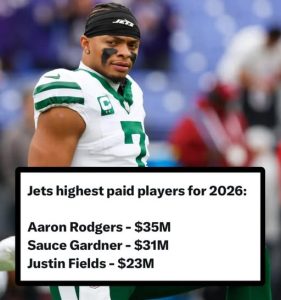
The graphic got more than 1,400 comments in a popular Facebook group (including a few from yours truly).
Here’s the problem: This graphic is wrong. I tried to explain this in the comments, but people weren’t listening.
Many fans are convinced that “dead money” is equal to real money. Many Jets fans are convinced that the Jets will still be paying a portion of the contracts given to Aaron Rodgers and Ahmad “Sauce” Gardner. But that’s not the case.
The Jets will not be paying Rodgers or Sauce in 2026. The Steelers will be paying Rodgers. The Colts will be paying Sauce.
Fans talk like Rodgers and Sauce will still be on the Jet’s payroll. As if the Jets will be giving those players new money in 2026. But that’s not the case.
The Jets are indeed slated to have their salary cap charged in 2026 with monies attached to Rodgers or Sauce. But that will not be new money being given to the players by the Jets.
Instead, money on the Jets’ books in 2026 for Aaron Rodgers and Sauce Gardner will be old money; those are sums to be charged against the salary cap to account for monies that the Jets previously paid to Rodgers and Sauce, in previous seasons, but were not ever charged against the NFL salary cap during those previous seasons.
Every Dollar (Eventually) Counts
Every single dollar that an NFL team pays a player must eventually be counted against the NFL salary cap. But NFL teams are not necessarily obligated to count every dollar that they give a player against the salary cap during the same season in which they paid out the money.
There are several mechanisms in the collective bargaining agreement (CBA), negotiated between the NFL owners and the NFLPA, that allow NFL teams to push monies into the future. In some cases, teams can push monies into several future seasons.
For example, in March 2022 the Green Bay Packers inked Rodgers to a contract extension. They paid Rodgers a total of $42 million in new money in the first year of that deal, but only $14.75 million actually counted against the Packers’ salary cap in 2022. The Packers pushed more than $27.25 million of the new money into 2023, 2024, and 2025.
That $27.25 million sum that was paid to Rodgers in 2022 but would not be accounted for until later seasons. This is the most common salary cap management tactic used by NFL teams.
However, when the Packers traded Rodgers to the New York Jets in 2023, that threw a wrench into their salary cap accounting game. The money that was pushed into the future would accelerate.
According to the CBA, if any NFL player is removed from a roster—whether by voided contract, trade, or release—any monies that have previously been paid to the player by the team but that have not yet been charged against the NFL salary cap must then be accelerated and fully charged against the salary cap immediately.
So, in the Packers case, the monies they paid Rodgers in 2022 that was not yet charged against the cap (the $27.25 million sum) would then count fully against the 2023 cap. The monies that were originally slated to be charged to the salary cap in 2024 and 2025 accelerated and counted in 2023. That’s the rules set by the CBA.
The Tangible Impact on the Jets
When the Jets acquired Rodgers from the Packers they inherited Rodgers’ contract, but the Jets and Rodgers later agreed to tweak the contract. The Jets would wind up paying Rodgers a total of $75 million over the 2023 and 2024 seasons. However, Rodgers only counted $8.9 million against the salary cap in 2023 and only $17.1 million against the salary cap in 2024.
Only $26 million of the $75 million was accounted for. This means that $49 million was still not accounted for. When the Jets decided to take on the ailing and aging QB in April 2023, they paid him handsomely in 2023 and 2024, but they opted to charge the bulk of his compensation against the salary cap in future seasons.
Moreover, the Jets drafted Sauce Gardner with the 4th overall pick in the 2022 draft. They paid him nearly $42.6 million between 2022 and 2025 (that includes monies from his rookie contract and the extension he signed with the team in July 2025). However, only $22.8 million of those sums ever counted against the NFL salary cap in those seasons.
This means, that there is still $19.8 million that was never accounted for in Sauce’s deal. Those were real dollars paid to Sauce by the New York Jets in previous seasons that still needed to be accounted for at the time he was traded to the Colts.
The Jets’ sum of $49 million, for Rodgers, and the $19.8 million sum, for Sauce, still need to be accounted for, at some point, because every single dollar spent by NFL teams must (eventually) count against the cap. The Jets accounted for some of these monies in 2025 and will account for the balance in 2026.
Post-June 1st Protocols
The salary cap accounting of “dead money” (also sometimes known as “accelerated monies”) actually varies based on what time of year the transaction took place.
In Rodgers’ case, his Jets contract was voided in March 2025, after the 2024 season. Therefore, the full sum of the unaccounted monies (the $49 million sum) accelerated and would now need to be charged against the Jets’ 2025 salary cap as “dead money.”
However, the NFL has a rule that all players traded or cut after June 1 have their accelerated monies charged against the cap spread out over two seasons.
But, wait, Rodgers was voided in March. Shouldn’t his entire sum of dead money have counted against 2025? Well, yes! But there’s a loophole.
The NFL and NFLPA implemented a new protocol in the most recent CBA that allows teams to cut a player during the off-season, prior to June 1, but still treat the player’s contract as if he was cut after June 1. They can do this with up to two players per off-season.
So, although Rodgers’ contract was voided in March 2025, he was designated to be treated as a post-June 1 cut, and his dead money hit was spread out over two seasons; his dead money accounted for $14 million against the Jets’ 2025 cap and will count for $35 million in 2026.
In Sauce Gardner’s case, since he was traded after June 1, the full sum of his uncharged monies ($19.8 million in his case) were spread out over two seasons. Apx. $8.8 million was accounted for against the 2025 salary cap and the balance (apx. $11 million of dead money) is slated to be charged against the Jets’ salary cap in 2026.
Note: The above-mentioned graphic asserts that Sauce’s number for 2026 is $31 million. That figure is incorrect.
Trade vs. Cut: Makes a Big Difference
When a player is cut (a.k.a., released) or his contract is voided (because of the “dummy years” mechanism), all guaranteed monies still left in the deal are to be paid and fully accounted for in the same season when the cut or void took place. (Of course, the only exception is the post-June 1 protocols, as explained above).
For example, The Jets are slated to pay QB Justin Fields $20 million in 2026, with $10 million of that sum being fully guaranteed. If the Jets were to cut Fields this off-season, they would still be on the hook for the $10 million guaranteed sum and 100% of that sum would count against the cap in 2026.
However, if the Jets were to trade Fields this off-season, his new team would inherit the contract that has $20 million remaining for the 2026 season, including the $10 million of guaranteed monies left in the deal. The Jets would not be on the hook for any of that $20 million.
But, of course, as explained herein this article already, the Jets would be on the hook for any monies that they previously paid Fields that has yet to be accounted for. In this case, the Jets paid Fields $20 million for the 2025 season, but only $8 million was accounted for against the cap. That’s $12 million unaccounted for. So if the Jets traded Fields, they’d take a $12 million dead money hit, but they would not be paying him any additional monies. His new team would be paying him.
The NFL team acquiring the player is always on the hook for future monies. The NFL team trading away the player is not on the hook for any new monies, but will be responsible to account for any previously unaccounted for monies.
Conclusion
Dead money is not new money. Dead money is not money that an NFL team is paying a player.
Dead money is money that a team has already paid a player, in the past. That money is already gone. It was simply never charged against the salary cap.
Fans should not view dead money as money that is being wasted by their favorite team. Instead, they ought to see it as money that was already spent by their favorite team.
Determining whether the money was wasted is dependent on the quality of play the team got from that player when he was still on the roster. In the case of Sauce Gardner, I think most Jets fans would say that he was worth it. But in the case of Aaron Rodgers, probably not.

Kenny is the chief content creator for thecapisfake.com and contributor at walterfootball.com. He’s also a adjunct professor, author, entrepreneur, Christian minister, and overall sports fanatic.